.png)
What Makes 6061 Aluminum One of the Most Versatile Alloys in Manufacturing?

Aluminum is the most abundant metallic element in the Earth’s crust, yet when it comes to manufacturing, few aluminum alloys achieve the legendary status and universal utility of 6061 Aluminum.
Often called the "workhorse" of the aluminum family, this medium-to-high strength heat-treatable alloy has become the global benchmark for applications requiring a balance of robust mechanical properties, excellent corrosion resistance, and simplified fabrication.
This deep dive explores the precise chemistry and superior characteristics that cement 6061 as an unrivaled material in virtually every major industry, from aerospace to consumer goods.
The Composition of 6061 Aluminium
The balanced properties of 6061 result from its precise alloying elements, primarily Magnesium (Mg) and Silicon (Si). As a 6000-series alloy, these elements form Magnesium Silicide, which is the compound responsible for the alloy's strength, especially after heat treatment.
Magnesium (0.8% to 1.2%) is the main contributor to 6061's high strength and its ability to respond to heat treatment. When combined with Si, the resulting Magnesium Silicide precipitates as tiny, hard particles during the aging process, leading to significant hardening within the aluminum microstructure.
Silicon (0.4% to 0.8%) is essential for creating the Magnesium Silicide strengthening compound. Additionally, silicon improves the fluidity of the molten aluminum, making 6061 an excellent choice for complex extrusion processes as it flows easily into intricate die shapes without defects.
Other elements are included in minor amounts. Copper (Cu) (less than 0.4%) slightly enhances strength and machinability while its low concentration preserves 6061's excellent corrosion resistance.
Iron (Fe) is minimized to prevent it from forming large, brittle compounds that would reduce the alloy's ductility and toughness.
The Mechanical Properties of 6061 Aluminium
The key to unlocking the full potential of this alloy lies in a process called heat treatment, which transforms its mechanical characteristics. Aluminum alloys like 6061 are capable of significant strengthening through thermal cycling, specifically achieving the popular and highly durable T6 temper.
1. T6 heat treatment
The T6 designation refers to a specific heat treatment sequence starting with solution heat treatment at approximately 530°C (985°F) to dissolve the Magnesium Silicide particles.
The material is then rapidly quenched in water, locking the Magnesium Silicide in solution and making the alloy initially soft and formable.
2. Artificial aging (strengthening)
The material is then artificially aged ("baked") at a lower temperature (around 175°C or 350°F).
During aging, excess Magnesium Silicide precipitates out in a controlled, finely dispersed manner. These tiny precipitates act as internal roadblocks to dislocation movement, resulting in a massive increase in the alloy's yield strength, tensile strength, and hardness.
3. Strength, Hardness, and Machinability
In its soft (O) temper, 6061 aluminum is highly ductile and easy to shape, with a relatively low tensile strength of around 18,000 psi. However, in the T6 temper, the alloy boasts a minimum ultimate tensile strength of 42,000 psi and a yield strength of 35,000 psi.
This jump in strength places it firmly in the structural category, capable of bearing significant loads. Furthermore, its machinability rating is quite good, making it easy to cut, drill, and shape into complex parts with excellent surface finish, although it is not considered "free-machining" like some other alloys.
Superior Performance Characteristics
Beyond its mechanical strength, 6061 aluminum's position as an industrial mainstay is solidified by its exceptional corrosion resistance and high degree of weldability. These two features significantly lower the complexity and cost of using the alloy in real-world environments.
6061 is one of the easiest heat-treatable aluminum alloys to weld, responding well to common techniques like MIG and TIG. Its low percentage of cracking elements makes the welding process reliable, usually resulting in a strong, sound weld zone.
Welding typically reduces material strength in the heat-affected zone (HAZ). For critical applications, post-weld heat treatment (re-T6) may be necessary to restore full strength. However, for most non-critical uses, the remaining base metal strength is often adequate, contributing to its versatility.
A significant advantage is 6061's outstanding natural corrosion resistance. When exposed to air, aluminum spontaneously forms a thin, tough, self-healing layer of aluminum oxide on its surface, which effectively shields the underlying metal from environmental degradation.
The low copper content in 6061's composition ensures it resists attack in harsh atmospheric and marine environments. This innate protection often eliminates the need for costly additional surface finishing for basic protection, making it ideal for exposed outdoor structures.
Unrivaled Versatility Materials
The combination of high strength (T6), formability (O/T4), excellent corrosion resistance, and easy weldability provides an optimal balance that few other alloys can match. This equilibrium is what allows 6061 to be specified for such a dizzying range of applications across global manufacturing.
1. Structural and architectural components
For projects that demand a lightweight yet sturdy frame, 6061 is the default choice. It is widely used for heavy-duty structural components, including bridge railings, building frameworks, platforms, and stairways where ease of on-site welding and atmospheric resistance are crucial factors.
Its ability to be extruded into complex, weight-saving profiles further enhances its structural utility.
2. Automotive and transportation
In the transportation sector, reducing weight is paramount to improving fuel efficiency and performance. 6061 aluminum is a prime material for truck and marine frames, rail cars, and numerous automotive components like wheel spacers, intake manifolds, and chassis parts.
Its fatigue resistance and strength-to-weight ratio provide engineers with the reliability they need for dynamic, high-stress environments.
3. Consumer goods and recreation
The alloy's widespread utility extends directly into the consumer market. It is the gold standard for high-performance bicycle frames, where its balance of strength, low weight, and cost-effective manufacturing is ideal.
Other common applications include fishing reels, camera lens mounts, photographic equipment, and specialized products like SCUBA and compressed air tanks, proving the sheer scope of its application. The sheer adaptability of 6061 Aluminum confirms its title as the industry’s most versatile workhorse.
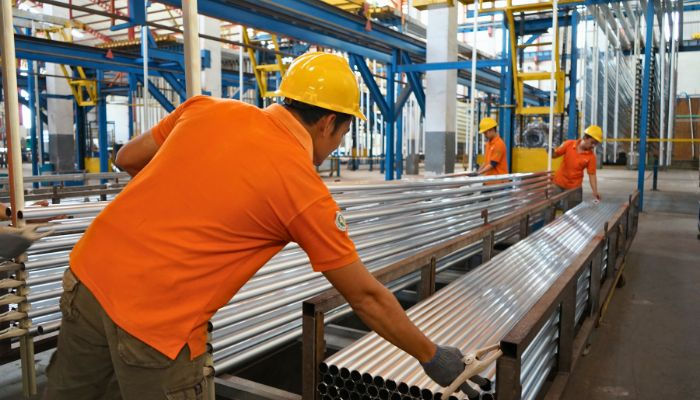
6061 Aluminum Manufacturing
As global industries continue to push toward lighter, stronger, and more sustainable materials, 6061 aluminum remains perfectly positioned for growth.
Its established manufacturing protocols, recyclability, and adaptable properties ensure that new, complex, and high-tech applications will continue to adopt it.
Whether used in additive manufacturing feedstock or in conventional extrusion for massive construction projects, the fundamental properties of 6061 will maintain its dominance as a foundational engineering material for decades to come.
The versatility of 6061 aluminum makes it crucial for countless industrial and consumer products. If your next project requires high-quality, reliable aluminum extrusions or components tailored to this alloy's properties, trust in experience.
PT Damai Abadi is a leading, integrated, and trusted aluminum extrusion manufacturer in Indonesia. Leveraging over 30 years of expertise and state-of-the-art facilities that include services in 6061 aluminium materials.
Reach out to PT Damai Abadi today to discuss how our specialized products and services can fulfill your manufacturing needs.


Comments