.png)
Design Advantages of Aluminium Extrusion for Modern Solar Panel Frame Systems

The renewable energy sector is constantly seeking material innovations that enhance efficiency, durability, and cost-effectiveness. In this critical search, aluminium extrusion for solar panel frames has emerged as the unequivocal industry-preferred solution.
The versatile and high-performance nature of extruded aluminum profiles directly addresses the rigorous demands placed on photovoltaic (PV) systems, ensuring long-term structural integrity and maximum energy output.
Why Aluminium Reigns Supreme?
Aluminium is globally recognized for its unique combination of properties, making it an ideal candidate for outdoor, long-life applications like solar frames. Its inherent material characteristics provide a foundational advantage over traditional or heavier structural metals.
The solar industry relies on standardization to ensure global compatibility, quality assurance, and project scalability. Extruded aluminum frames are central to achieving this standardization across different panel manufacturers and regional markets.
Aluminium Extrusion for Modern Solar Panel
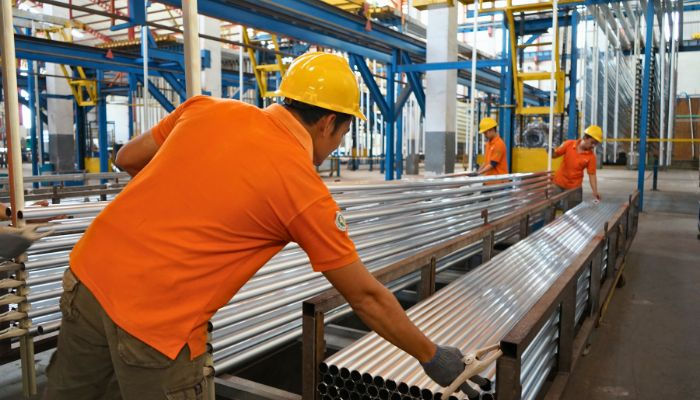
The term "extrusion" refers to the process where a heated aluminum billet is pushed through a shaped die, creating a continuous profile. This manufacturing method is the key enabler of the design flexibility that has revolutionized solar frame construction.
Below are the advantages of aluminium extrusion for modern solar panel.
1. Unmatched strength-to-weight ratio
One of the most significant benefits of using aluminum is its incredible strength relative to its low weight. Solar panels must withstand harsh environmental conditions, including heavy winds, snow loads, and seismic activity, without adding excessive bulk.
Extruded aluminum frames provide the necessary structural rigidity to protect the delicate PV cells within the module, ensuring they can absorb significant external forces. This lightweight nature simultaneously lowers the logistical costs associated with shipping and installation.
2. Complete recyclability and sustainability
In the renewable energy sector, sustainability is not just a feature; it is a necessity. Aluminum is infinitely recyclable without losing its material properties, making it a champion of the circular economy.
The choice of aluminum frames aligns perfectly with the overarching mission of solar power: reducing the global carbon footprint. Utilizing this material allows manufacturers to offer an end-of-life solution for the frame components.
3. Shaping efficiency
Unlike rolling or casting, extrusion allows engineers to create extremely complex, highly optimized cross-sections and hollow chambers. This capability means a solar frame is no longer just a simple bracket but a multi-functional component.
Designers can place metal precisely where strength is needed most and remove it where it is superfluous, reducing material usage and cost while maintaining peak performance. This precision ensures that every frame produced is uniform.
4. Integrated design for complex functionality
The ability to create complex geometries allows for the direct integration of functional features into the frame profile. Mounting systems, for instance, can be designed with integrated T-slots or dedicated channels.
These features eliminate the need for cumbersome, bolted-on brackets and allow for quick, tool-less attachment of panel clamps and racking systems. The streamlined, integrated design creates a cleaner, more aesthetically pleasing look for the final solar array.
5. Efficient heat dissipation for higher output
Aluminum possesses excellent thermal conductivity, meaning it can efficiently transfer heat away from the PV cell module. The extruded frame acts as a passive heatsink, drawing excess heat from the module edges and radiating it into the surrounding air.
This efficient heat transfer is crucial in hot climates, where panels can easily overheat and suffer significant derating in power production. By keeping the operating temperature within optimal limits, the aluminium extrusion for solar panel frames directly contributes to higher overall energy yield.
6. Inherent Corrosion and Weather Resistance
Solar panels are deployed in diverse and often challenging environments, ranging from coastal areas with high salinity to industrial zones with corrosive atmospheres. Aluminum naturally forms a thin, dense layer of aluminum oxide when exposed to air.
This passive layer is highly resistant to corrosion, protecting the underlying metal from weathering, rust, and chemical damage. Surface treatments like anodizing or powder coating can be applied to extruded profiles to create an even more durable.
7. Tight dimensional tolerances
The extrusion process offers extremely tight dimensional tolerances, meaning that every meter of the profile is nearly identical in shape and size. This precision is vital for large arrays where thousands of panels must fit together seamlessly without adjustment.
Consistency in the frame dimensions ensures a perfect fit for gaskets, cell-holding channels, and mounting clamps, which in turn guarantees the panel’s waterproofing and structural integrity over its expected 25-to-30-year operational life. E
8. Maximizing Material Utilisation
The design freedom afforded by extrusion allows engineers to remove material where it is not structurally required, often creating hollow or intricate sections. This process, known as profile optimization, minimizes the weight and volume of the frame while maintaining or even increasing its strength.
9. Streamlined manufacturing and assembly
The uniformity of extruded profiles lends itself perfectly to automated manufacturing processes. Components can be cut, punched, and drilled with high-speed CNC machinery, reducing human error and boosting production volume.
The interlocking features and dedicated channels integrated into the frame design significantly speed up the final assembly of the solar module itself. Quick assembly processes minimize factory lead times.
10. Simplified transportation and installation
Since aluminum is significantly lighter than steel, the transportation costs for shipping solar panels, which are bulky goods, are markedly reduced. More frames can be transported per truckload, cutting down on fuel usage and logistics expenses.
On the installation side, lighter frames mean less strain on workers and simpler rigging requirements on rooftops. This ease of handling accelerates the on-site installation process, ensuring that large-scale solar farms can be commissioned on time and within budget.
The Future of Solar is Extruded
The dominance of aluminium extrusion for solar panel framing systems is not accidental; it is a direct consequence of superior material science meeting modern engineering demands.
Extruded aluminum offers the perfect synergy of low weight, high strength, thermal efficiency, and corrosion resistance, all while enabling complex, integrated designs that simplify assembly and installation.
For manufacturers and developers in the renewable energy sector, choosing this technology is choosing longevity, efficiency, and a robust pathway to sustainable energy production.
Ready to secure the efficiency and longevity of your solar projects?
PT Damai Abadi provides integrated solutions. With facilities in Medan and Tangerang, and in-house design, molding, and various surface processing techniques like anodizing and powder coating, we ensure dependable quality and competitive pricing for your modern solar panel frame needs.
Contact PT Damai Abadi today to discuss specialized aluminium extrusion services that meet your precise structural and design requirements.


Comments