.png)
How to Check Extrusion Strength for Structural Applications
Why It Is Important to Check Extrusion Strength
In structural applications, material performance is directly linked to safety, reliability, and long term durability.
For aluminum components, knowing how to check extrusion strength is essential before profiles are approved for use in load bearing or structural systems.
Aluminium extrusion strength determines whether a profile can withstand applied loads, environmental stress, and operational demands over time.
Understanding Extrusion Strength
Extrusion strength refers to the ability of an aluminium extrusion to resist deformation, bending, or failure when subjected to mechanical loads.
It is influenced by material composition, profile design, heat treatment, and manufacturing consistency.
Checking extrusion strength ensures that the profile meets engineering and regulatory requirements.
Mechanical Properties Used to Check Extrusion Strength
Several mechanical properties are commonly evaluated.
1. Tensile Strength
Tensile strength measures the maximum stress an extrusion can withstand before breaking when pulled.
This value indicates the material’s resistance to failure under tension and is a fundamental parameter in structural design.
2. Yield Strength
Yield strength defines the stress level at which permanent deformation begins.
For structural applications, yield strength is often more critical than tensile strength because it determines safe load limits during normal operation.
3. Elongation
Elongation measures how much a material can stretch before fracture.
Adequate elongation indicates ductility, which helps prevent sudden brittle failure under load.
HOW TO CHECK EXTRUSION STRENGTH
Extrusion strength is verified through standardized testing and evaluation methods.
1. Tensile Testing
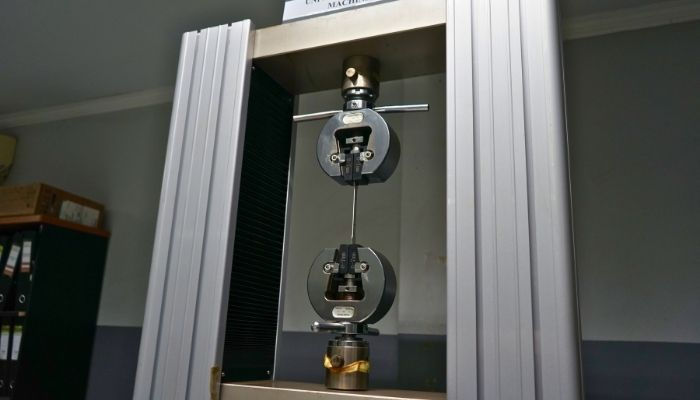
Tensile testing is the most common method used to check extrusion strength.
Test specimens are pulled under controlled conditions to measure tensile strength, yield strength, and elongation. Results are compared against material standards and project requirements.
2. Hardness Testing
Hardness testing provides an indirect indication of strength.
While not a replacement for tensile testing, hardness measurements help verify material consistency and heat treatment effectiveness.
3. Load and Structural Testing
For critical applications, extruded profiles may undergo load testing or structural simulation to validate performance under real world conditions.
Role of Alloy Selection in Extrusion Strength
Alloy selection has a major impact on extrusion strength.
High strength alloys offer greater load bearing capacity, while standard extrusion alloys balance strength with formability and surface quality.
Choosing the right alloy is a key step when checking extrusion strength for structural use.
Influence of Heat Treatment on Strength
Heat treatment significantly enhances extrusion strength.
Processes such as solution heat treatment and aging improve mechanical properties by optimizing the alloy’s microstructure.
Proper heat treatment must be verified as part of extrusion strength evaluation.
Profile Design and Structural Performance
Extrusion strength is not determined by material alone.
1. Cross Section Geometry
Profile shape influences load distribution and resistance to bending or torsion.
Well designed geometries can achieve higher structural performance without increasing material usage.
2. Wall Thickness and Reinforcement
Consistent wall thickness and integrated reinforcement features improve strength and stability under load.
Quality Control and Consistency
Reliable extrusion strength depends on manufacturing control.
Consistent billet quality, precise extrusion parameters, controlled cooling, and verified heat treatment ensure uniform strength across production batches.
Industry Standards and Compliance
Structural aluminium extrusions are often required to meet international or regional standards.
Checking extrusion strength against recognized standards provides confidence in performance and regulatory compliance.
Issues Identified When Checking Extrusion Strength
Strength evaluation can reveal potential issues.
Inadequate heat treatment
Incorrect alloy selection
Dimensional inconsistency
Internal defects or porosity
Early detection prevents costly failures during installation or service.
Importance of Working with a Qualified Manufacturer
Manufacturing expertise plays a critical role in extrusion strength.
Experienced manufacturers apply controlled processes, testing, and documentation to ensure extrusions meet specified strength requirements.
Aluminium Manufacturer
PT. Damai Abadi applies strict quality control and testing procedures to check extrusion strength for structural applications.
Through controlled extrusion processes, proper heat treatment, and mechanical testing, PT. Damai Abadi ensures aluminium extrusions meet required performance standards.
This approach provides customers with confidence in structural reliability and long term durability.
Ensuring Structural Safety Through Strength Verification
Knowing how to check extrusion strength is essential for any structural application involving aluminium extrusions.
By evaluating mechanical properties, verifying heat treatment, and ensuring manufacturing consistency, engineers and project owners can achieve safe and reliable structural performance.
For aluminium extrusion solutions supported by verified strength testing and manufacturing expertise, PT. Damai Abadi offers reliable capabilities for structural and industrial applications.


Comments