.png)
Extrusion Quality Control Checklist Every Manufacturer Should Follow
Why Quality Control Is Critical in Aluminium Extrusion
In aluminium extrusion manufacturing, quality is not something that can be inspected at the end of production alone.
It must be built into every stage of the process. An effective extrusion quality control checklist ensures that aluminium profiles meet dimensional accuracy, mechanical strength, surface finish, and performance requirements consistently.
Without proper quality control, extrusion defects may go unnoticed until installation or end use, leading to costly rework, delays, and potential project failure.
For manufacturers and project owners alike, a structured approach to quality control is essential for maintaining reliability and long term performance.
Extrusion Quality Control Checklist
An extrusion quality control checklist is a systematic framework used to monitor, measure, and verify quality throughout the aluminium extrusion process.
It covers raw material inspection, process control, dimensional verification, surface quality, and final inspection.
Rather than relying on reactive corrections, a checklist driven approach allows manufacturers to detect deviations early and maintain consistent standards across production batches.
This methodology is particularly important for aluminium extrusion profiles used in industrial, architectural, and high performance applications.
Why Needs an Extrusion Quality Control Checklist
Aluminium extrusion involves complex variables, including alloy composition, temperature control, die condition, and handling processes.
A quality control checklist helps manage these variables effectively :
• Ensures dimensional and mechanical consistency
• Reduces scrap and rework costs
• Improves customer confidence and trust
• Supports compliance with industry standards
• Enhances long term product reliability
Quality control is not only a technical requirement but also a strategic advantage in competitive manufacturing environments.
Raw Material Inspection
The foundation of any extrusion quality control checklist begins with raw material verification.
1. Alloy Composition Verification
Aluminium alloy composition directly affects extrusion behavior and final product performance. Incoming billets must be verified against specified alloy grades to ensure compatibility with application requirements.
Chemical composition checks help prevent inconsistencies that could lead to mechanical weakness or surface defects.
2. Billet Quality and Homogeneity
Billets should be free from cracks, contamination, or surface defects. Uniform billet structure ensures smooth metal flow during extrusion and consistent profile quality.
Poor billet quality can compromise the entire extrusion process regardless of downstream controls.
Die Inspection and Preparation
Extrusion dies play a critical role in shaping aluminium profiles. Proper die management is a key component of any extrusion quality control checklist.
1. Die Design Verification
Die geometry must match the required profile dimensions and tolerances. Design accuracy ensures uniform metal flow and reduces the risk of distortion or dimensional deviation.
2. Die Condition and Cleanliness
Worn or damaged dies can cause surface lines, dimensional inaccuracies, or uneven wall thickness. Regular inspection and maintenance are essential to maintain extrusion quality.
Clean dies also prevent surface contamination on finished profiles.
Process Control During Extrusion
Maintaining stable extrusion parameters is essential for consistent output.
1. Temperature Control
Billet temperature, container temperature, and die temperature must be carefully monitored. Incorrect temperatures can lead to surface defects, internal stress, or incomplete extrusion.
Consistent temperature control supports smooth metal flow and uniform mechanical properties.
2. Extrusion Speed and Pressure
Extrusion speed must be optimized to balance productivity and quality. Excessive speed may cause tearing or surface defects, while low speed can affect material properties.
Pressure consistency ensures even material flow and dimensional stability.
Dimensional Inspection
Dimensional accuracy is a core requirement in aluminium extrusion manufacturing.
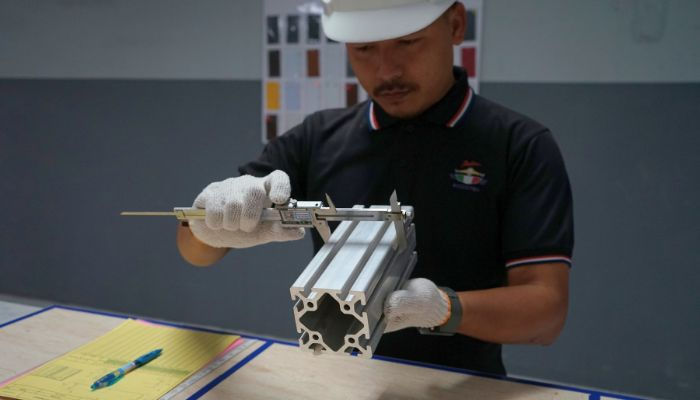
1. Profile Dimension Verification
Key dimensions such as width, height, wall thickness, and slot geometry must be measured against specifications. This step ensures compatibility with assembly and installation requirements.
2. Straightness and Twist Control
Extruded profiles should be checked for straightness, bowing, and twist. Deviations can affect structural performance and aesthetic appearance.
Dimensional inspection should be performed at regular intervals throughout production.
Surface Quality Inspection
Surface quality significantly influences both performance and appearance.
1. Visual Surface Inspection
Profiles should be inspected for scratches, dents, streaks, or die lines. Early detection allows corrective action before further processing.
2. Surface Finish Consistency
Uniform surface texture is essential for downstream processes such as anodizing or coating. Inconsistent finishes can result in uneven appearance after finishing.
Surface quality inspection is a critical step in the extrusion quality control checklist.
Mechanical Property Verification
Mechanical performance must align with application requirements.
1. Tensile Strength and Hardness Testing
Mechanical testing verifies that aluminium extrusion profiles meet strength and hardness specifications. These tests confirm the effectiveness of heat treatment and material integrity.
2. Heat Treatment Verification
Heat treated profiles must be checked for correct temper condition. Improper heat treatment can result in reduced strength or dimensional instability.
Handling and Storage Control
Quality control extends beyond extrusion itself.
1. Profile Handling Procedures
Improper handling can introduce scratches or deformation. Controlled handling procedures help preserve surface quality and dimensional accuracy.
2. Storage Environment
Profiles should be stored in clean, dry environments to prevent contamination or corrosion before finishing or delivery.
Final Inspection and Documentation
Final inspection ensures that all quality criteria have been met before shipment.
1. Final Product Inspection
A comprehensive final inspection confirms dimensional accuracy, surface quality, and mechanical properties. Only compliant profiles should proceed to packaging.
2. Documentation and Traceability
Quality records, inspection reports, and batch traceability support accountability and continuous improvement. Documentation also helps address any future quality inquiries efficiently.
Common Issues Prevented by a Proper Quality Control Checklist
An effective extrusion quality control checklist helps prevent common manufacturing issues.
• Dimensional inconsistencies
• Surface defects affecting finishing quality
• Mechanical performance failures
• Rejected batches and delivery delays
• Increased warranty and maintenance costs
Preventive quality control is always more efficient than corrective action.
PT. Damai Abadi’s Quality Control Philosophy
PT. Damai Abadi applies a structured extrusion quality control checklist across every stage of its manufacturing process.
From raw material inspection to final product verification, quality is managed systematically rather than reactively.
This disciplined approach allows PT. Damai Abadi to deliver aluminium extrusion profiles that meet industry standards and customer expectations consistently.
By prioritizing process control, documentation, and continuous improvement, the company supports long term project success for its clients.
Applications That Depend on Strict Extrusion Quality Control
High quality aluminium extrusion profiles are essential in many industries.
• Industrial machinery and automation systems
• Architectural and facade applications
• Transportation and logistics infrastructure
• Energy and power generation projects
• Precision engineered assemblies
In these applications, reliable quality control is non negotiable.
Quality Control as a Manufacturing Standard
An extrusion quality control checklist is not just a guideline. It is a manufacturing standard that ensures aluminium extrusion profiles perform as intended throughout their lifecycle.
By implementing structured quality control at every stage, manufacturers reduce risk, improve consistency, and build long term trust with their clients.
With its commitment to disciplined quality management, PT. Damai Abadi continues to provide aluminium extrusion solutions designed for precision, reliability, and performance.
For more information about aluminium extrusion quality standards or to discuss project requirements, consult with PT. Damai Abadi’s experienced technical team.


Comments