.png)
Engineering Benefits of Hollow Aluminium Extrusion in Modern Construction
- PT Damai Abadi .
- Dec 3, 2025
- 5 min read

The use of hollow aluminium extrusion profiles has become a cornerstone of contemporary architecture, providing engineers and designers with versatile solutions for complex building challenges.
This article explores the core engineering advantages of these profiles, highlighting why they are indispensable for achieving superior structural integrity, thermal efficiency, and streamlined on-site assembly in today’s demanding building environment.
Hollow Aluminium Extrusion
Aluminium extrusion is fundamentally a process where heated aluminium material is pushed through a specially shaped tool called a die. This action forces the metal to take the exact cross-sectional shape of the die opening, similar to squeezing toothpaste from a tube.
For the creation of a hollow aluminium extrusion profile, a specialized die known as a mandrel is used to simultaneously form the outer shape and the internal voids or chambers.
The resulting product is a piece of aluminium with a precise, consistent cross-section that features one or more internal cavities. These internal chambers are the defining characteristic of a hollow profile, setting it apart from solid bars or simple pipes.
This engineering marvel is what allows designers to optimize material placement for maximum structural efficiency, forming the basis for its superior performance in construction.
The Benefits of Hollow Aluminium Extrusion
Hollow aluminum extrusions unlock the material's full engineering potential by maximizing its mechanical properties, resulting in a profile that is incredibly stiff and strong relative to its weight, often surpassing traditional heavy materials like steel in structural applications.
This optimal strength-to-weight balance provides cascading construction benefits, read more below.
1. Lighter loads, greater design freedom
The reduced mass of hollow aluminium extrusions is a critical factor for logistics, making transportation to the construction site easier and less costly. Fewer heavy lifting mechanisms are required on site, improving safety and setup speed.
For projects involving renovations or additions to existing structures, the lighter weight minimizes the impact on the original building's capacity, allowing for expansion where traditional heavy materials would be prohibitive.
2. Optimizing building performance
The move toward green building standards and net-zero energy goals makes thermal performance a non-negotiable requirement for modern materials. The unique architecture of a hollow aluminium extrusion is perfectly suited to meet these stringent energy demands.
Its internal cavities can be intelligently utilized to enhance the building envelope's resistance to heat transfer.
3. Superior thermal efficiency
The cavity within the extrusion can be customized to accept multi-chamber designs, which trap pockets of air, acting as natural insulators. This design is crucial for curtain wall systems and large glazed areas, where thermal bridging is a primary concern for energy loss.
The ability to integrate these high-performance features directly into the profile's design makes aluminium the material of choice for LEED-certified and other highly efficient structures. Furthermore, aluminium is 100% recyclable without loss of quality, contributing to the circular economy and boosting a project’s environmental rating.
4. Durability and corrosion resistance
In the long-term calculus of construction, durability is just as important as initial strength. Aluminium inherently possesses outstanding resistance to corrosion, especially when compared to ferrous metals, which require constant protective coating.
This natural resistance is formed by a thin, protective layer of aluminium oxide that quickly forms on the surface when exposed to air. For coastal or high-humidity environments, this resistance is invaluable, guaranteeing a long lifespan with minimal maintenance costs.
5. Streamlining the construction process
One of the most powerful, yet often overlooked, advantages of hollow aluminium profiles is their impact on construction efficiency and logistics.
The extrusion process is inherently precise, producing components with extremely tight dimensional tolerances that are far superior to those achieved through traditional casting or welding of other metals. This precision is key to modern construction’s modular approach.
6. Precision and reduced on-site complexity
The modular nature of extruded components allows for pre-fabrication, where large sections of the building envelope or structural elements can be assembled in a controlled factory environment.
These large, finished units are then transported to the site and installed quickly, minimizing disruption and speeding up the overall construction schedule. This shift from labor-intensive site work to efficient, quality-controlled factory production represents a paradigm shift in project delivery.
7. The Adaptability of custom profiles
The extrusion die process is highly versatile, allowing manufacturers to create complex, multi-functional profiles that integrate several features into a single component. A single hollow profile can incorporate channels for wiring, internal tracks for movable partitions, and precise slots for mechanical fasteners.
This eliminates the need for multiple, separate components. This design capability significantly simplifies the bill of materials (BOM) and reduces the number of parts that need to be tracked and managed on site.
Key Applications in Contemporary Architecture
The engineering benefits of aluminium extrusion are best demonstrated by the wide array of high-profile applications it enables in modern building design. These profiles are no longer just supplementary materials.
1. Next-generation curtain wall systems
Hollow aluminum extrusions are critical for advanced glazing and curtain wall systems, providing lightweight strength for securing heavy glass against wind loads.
Their precise, customizable profiles allow for the seamless integration of drainage, wiring, and thermal breaks, ensuring high structural integrity and energy efficiency in complex, modern facades.
2. Structural framing and support elements
Aluminum extrusions are expanding beyond secondary roles into semi-structural framing, used in trusses and mounting systems due to their corrosion resistance and reliable mechanical properties.
Crucially, in modular construction, pre-finished aluminum framing enables rapid, precise factory assembly of modules for fast-track projects like specialized data centers or temporary facilities.
3. Specialized architectural elements
Hollow aluminum extrusions are ideal for specialized architectural components due to the ease of fabrication and finishing, creating highly detailed, durable, and maintenance-free elements.
This customization capability allows architects to achieve a signature look for a project while reliably meeting all safety and performance standards.
The Engineering Superiority of This Materials
The engineering superiority of the hollow aluminum extrusion profile is undeniable. It delivers a comprehensive suite of benefits, including an unparalleled strength-to-weight ratio, critical thermal performance for sustainable design, and a highly efficient, precision-based construction methodology.
As building codes become stricter and the demand for environmentally conscious, high-performance structures grows, the role of extruded aluminium will only expand. It stands as a vital, future-proof material, enabling architects and engineers to create the smarter, lighter, and more sustainable buildings of tomorrow.
Ready to integrate the high-performance engineering benefits of hollow aluminium extrusion into your next project? PT Damai Abadi is equipped to meet your needs.
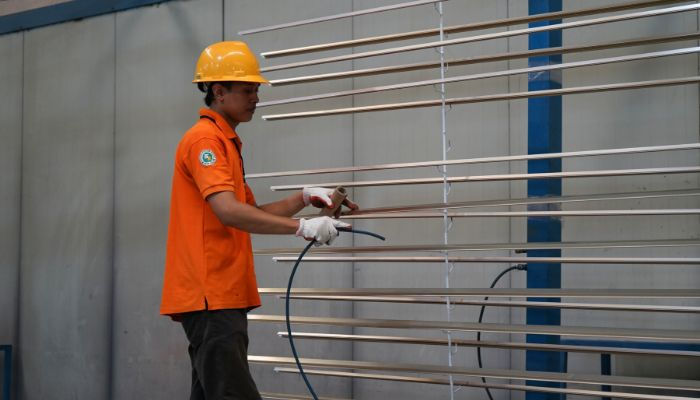
We utilize advanced production equipment and offer a full range of surface processing, including anodizing and powder coating, to provide top-quality profiles at economical prices.
Reach out to PT Damai Abadi today to discuss your structural framing, curtain wall, or specialized architectural element requirements and discover the difference precision and reliability can make.


Comments