.png)
Aluminum Extrusion Dies - How Die Design Influences Profile Accuracy

The Importance of Die Design in Aluminum Extrusion
Aluminum Extrusion Dies play a critical role in determining the accuracy, consistency, and performance of extruded aluminum profiles.
While extrusion presses and alloys often receive significant attention, the die itself is the foundation of dimensional precision.
A well designed extrusion die ensures that aluminum flows evenly, maintains structural integrity, and meets tight tolerance requirements. For industries that rely on precision manufacturing, understanding how die design influences profile accuracy is essential.
What Are Aluminum Extrusion Dies?
Aluminum Extrusion Dies are specialized steel tools used to shape heated aluminum billets into specific cross sectional profiles.
As aluminum is forced through the die opening under high pressure, it takes the exact shape defined by the die.
Because dies must withstand extreme heat, pressure, and friction, they are typically manufactured from high strength tool steel and engineered for durability and precision.
Types of Aluminum Extrusion Dies
Different profile requirements call for different die designs.
1. Solid Dies
Solid dies are used for simple, solid profiles without internal cavities. They are commonly applied in flat bars, angles, and basic structural shapes.
2. Hollow Dies
Hollow dies are designed for profiles with internal voids, such as tubes and complex architectural sections. They require precise internal support to maintain dimensional stability.
3. Semi Hollow Dies
Semi hollow dies fall between solid and hollow designs. They are used for profiles with partially enclosed shapes that still demand careful metal flow control.
How Die Design Influences Profile Accuracy
Die design directly affects how aluminum flows during extrusion and how accurately the final profile matches specifications.
1. Metal Flow Balance
A well balanced die ensures uniform aluminum flow across the profile. Uneven flow can cause distortion, twisting, or dimensional variation.
2. Dimensional Tolerances
Die geometry determines wall thickness, corner sharpness, and profile symmetry. Precision die machining allows tighter tolerances and consistent repeatability.
3. Surface Finish Quality
Die bearing lengths and surface polishing influence the smoothness of the extruded surface. Poor die conditions can lead to lines, scratches, or surface defects.
4. Profile Straightness and Stability
Improper die design may result in profile bending or warping after extrusion. Accurate die alignment supports straight and stable profiles, especially for long lengths.
Key Die Design Elements
Several technical aspects must be carefully engineered.
1. Die Bearing Length
Bearing length controls metal speed and flow consistency. Proper bearing design balances pressure across the profile and minimizes distortion.
2. Die Land Geometry
The land area defines final shape accuracy. Precision machining of this area ensures the profile matches design intent.
3. Cooling and Heat Distribution
Even heat distribution within the die prevents uneven expansion and improves dimensional stability during extrusion.
Common Issues Caused by Poor Die Design
Inadequate die engineering often leads to quality challenges.
• Profile twisting or bowing
• Inconsistent wall thickness
• Surface defects or die lines
• Increased scrap and rework
• Reduced extrusion speed
These issues increase production costs and compromise performance.
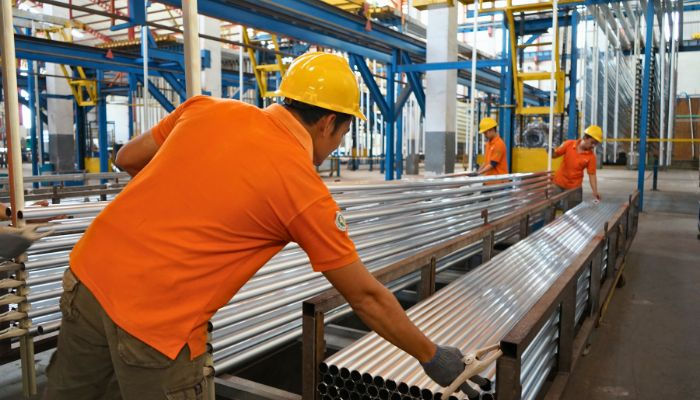
Aluminum Extrusion Factory
Even well designed Aluminum Extrusion Dies require proper maintenance. Over time, wear and thermal stress can affect accuracy.
Regular inspection, polishing, and refurbishment ensure dies continue to produce consistent, high quality profiles throughout their service life.
At PT. Damai Abadi, die design is treated as a strategic component of aluminum extrusion manufacturing.
The company collaborates closely with customers during the design stage to ensure profiles are optimized for both performance and manufacturability.
Precision die engineering, combined with controlled extrusion parameters, helps deliver accurate and repeatable results.
With integrated extrusion, anodizing, and fabrication capabilities, PT. Damai Abadi ensures that profile accuracy is maintained from initial die design to final product delivery.
Die Design Determines Extrusion Success
Aluminum Extrusion Dies are more than shaping tools. They are the foundation of dimensional accuracy, surface quality, and production efficiency.
By investing in proper die design and maintenance, manufacturers can achieve consistent profile accuracy, reduce defects, and support long term project success.
For precision aluminum extrusion supported by expert die design and manufacturing control, PT. Damai Abadi offers reliable solutions tailored to your specifications.


Comments