.png)
Powder Coating Aluminium Profiles: Process, Benefits, and Performance Explained
Aluminium is widely recognized for its excellent strength, lightweight properties, and natural resistance to corrosion.
While these characteristics make it suitable for a broad range of industries, many applications require an additional protective and decorative finish to improve durability and enhance appearance.
One of the most popular finishing methods used today is powder coating aluminium profile.
Powder coating not only creates a clean and attractive surface but also provides long lasting protection against weather, corrosion, abrasion, and daily wear.
As a result, powder coated aluminium profiles are commonly used in architectural projects, industrial equipment, transportation, and consumer products where both performance and aesthetics are important.
Understanding how the powder coating process works, its advantages, and the factors that influence coating quality can help businesses choose the right finishing solution for their aluminium products.
POWDER COATING ALUMINIUM PROFILE
Powder coating is a finishing process in which a dry powder coating material is electrostatically applied to the surface of an aluminium profile before being cured in a high temperature oven.
During curing, the powder melts and forms a smooth, durable coating that bonds tightly to the aluminium surface.
Unlike conventional liquid paint, powder coating does not rely on solvents.
This allows the coating to produce a thicker and more uniform finish while providing excellent durability and environmental performance.
Because of its versatility, powder coating is available in a wide variety of colors, textures, and gloss levels, making it suitable for both functional and decorative applications.
Powder Coating Process Works
Producing a high quality powder coated aluminium profile involves several carefully controlled stages.
Each step contributes to the durability, appearance, and long term performance of the finished product.
The process generally includes :
Surface Preparation
Before coating begins, the aluminium profile must be thoroughly cleaned to remove oil, dust, oxidation, and other contaminants. Proper surface preparation is essential for achieving strong coating adhesion.
Powder Application
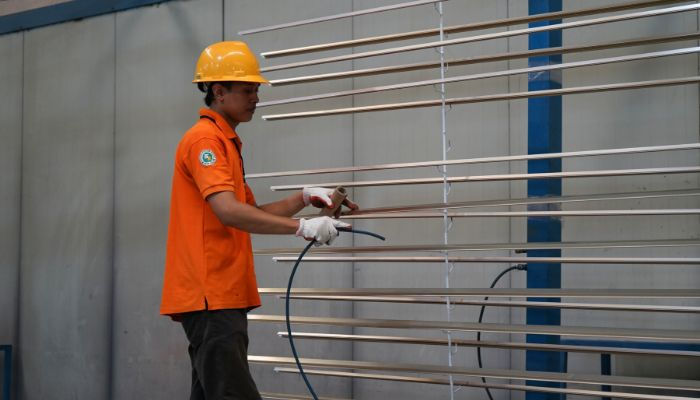
The powder coating material is sprayed onto the aluminium profile using electrostatic equipment. The electrically charged powder particles adhere evenly to the metal surface.
Heat Curing
After application, the coated profile is placed inside a curing oven. Heat causes the powder to melt, flow evenly across the surface, and chemically bond into a durable protective layer.
Cooling and Inspection
Once curing is complete, the profiles are cooled before undergoing quality inspections to verify coating thickness, appearance, and overall finish quality.
Careful control throughout each stage helps ensure consistent coating performance and an attractive final appearance.
Benefits of Powder Coated Aluminium Profiles
Powder coating offers more than visual appeal. It significantly improves the overall performance and service life of aluminium products used in demanding environments.
Some of the key advantages include :
1. Superior Corrosion Protection
One of the primary reasons powder coating is widely used is its ability to provide additional protection against moisture, humidity, and environmental exposure.
Combined with aluminium's natural corrosion resistance, powder coating creates an extra barrier that helps extend product lifespan in outdoor applications.
2. Enhanced Surface Durability
Powder coated surfaces are highly resistant to scratches, impacts, and everyday wear.
This makes them suitable for products that experience frequent handling or are exposed to challenging operating conditions.
3. Attractive and Consistent Appearance
Powder coating produces a smooth, uniform finish that enhances the overall appearance of aluminium profiles.
With numerous color and texture options available, designers have greater flexibility to meet architectural or branding requirements.
4. Lower Maintenance Requirements
Because powder coated surfaces resist fading, peeling, and corrosion, they generally require minimal maintenance throughout their service life.
Routine cleaning is often sufficient to preserve both appearance and performance.
Common Applications Across Industries
The combination of durability and design flexibility makes powder coated aluminium profiles suitable for many different industries.
Common applications include :
· Building facades and architectural systems
· Doors and window frames
· Curtain wall structures
· Industrial machinery
· Transportation components
· Furniture and interior systems
· Solar energy mounting structures
Whether the priority is structural performance or visual appeal, powder coating provides an effective finishing solution for a wide range of aluminium products.
Factors That Influence Coating Quality
Not all powder coated aluminium profiles deliver the same level of performance. The final quality depends on several important manufacturing factors.
These include :
· Proper surface preparation before coating
· High quality powder coating materials
· Accurate control of curing temperature and time
· Consistent coating thickness
· Thorough quality inspection after production
Even a well designed aluminium profile can experience coating issues if these factors are not carefully managed.
This is why choosing an experienced aluminium manufacturer with comprehensive finishing capabilities is an important part of achieving reliable long term performance.
Aluminium Manufacturing Partner
The quality of powder coated aluminium profiles depends not only on the coating material itself but also on the expertise of the manufacturer performing the finishing process.
An experienced manufacturing partner understands how extrusion quality, surface preparation, coating application, and quality control all work together to produce reliable results.
When selecting an aluminium supplier, businesses should consider :
· Manufacturing experience
· Integrated extrusion and finishing capabilities
· Quality assurance procedures
· Ability to support custom project requirements
· Consistency across production batches
At PT Damai Abadi, we understand that surface finishing is an important part of overall product performance.
Our team works closely with customers to recommend aluminium extrusion solutions that meet both functional and aesthetic requirements.
Supported by precision manufacturing and comprehensive quality control, we strive to deliver aluminium profiles that perform reliably across a wide range of applications.
Conclusion
Powder coating aluminium profile is one of the most effective finishing methods for improving both the appearance and durability of aluminium products.
Through a carefully controlled application and curing process, powder coating provides excellent protection against corrosion, scratches, weather exposure, and daily wear while offering a wide range of design possibilities.
Understanding the powder coating process, its benefits, and the factors that influence coating quality enables businesses to make better decisions when selecting aluminium products for construction, industrial, and engineering projects.
At PT Damai Abadi, we are committed to delivering high quality aluminium extrusion solutions supported by reliable manufacturing processes and professional customer service.
Whether your project requires standard aluminium profiles or customized extrusion products with powder coating finishes, our team is ready to help you find the right solution.
Contact PT Damai Abadi today to discuss your aluminium extrusion requirements and discover how our manufacturing expertise can support your next project with quality, precision, and long lasting performance.


Comments